
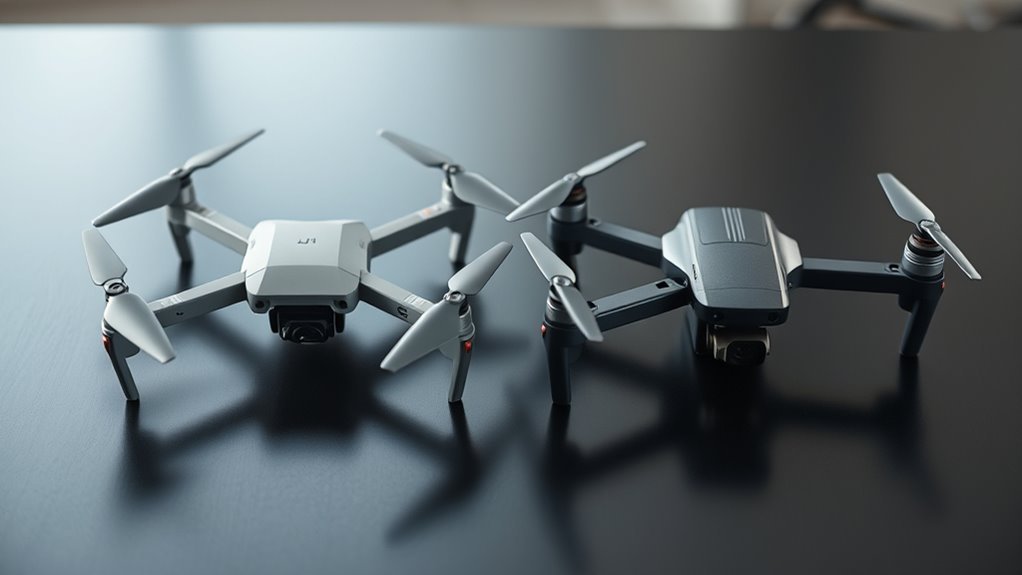
If you’re comparing the JJRC H78G’s compact 15-minute flights to the Potensic Atom 2’s budget-friendly 32-minute endurance, you’ll notice the H78G’s lightweight, basic design suits quick outings with a 1080p camera, while the Atom 2 offers superior build quality and 4K imaging for better results. Controls are intuitive on both, but the Atom 2 provides longer range and stability. Check further aspects to see which fits your needs best.
Design and Build Quality
When comparing the design and build quality of the JJRC H78G and Potensic Atom 2, you’ll notice key differences in materials and durability. The JJRC H78G relies on basic plastic components, offering decent material quality for entry-level users, but its design aesthetics feel simplistic and less refined, with a bulkier frame that prioritizes affordability over elegance. In contrast, the Potensic Atom 2 elevates material quality with higher-grade plastics and reinforced elements, enhancing its overall sturdiness for more adventurous flights.
You’ll appreciate how these choices empower your exploration. The H78G’s straightforward design aesthetics make it lightweight and easy to handle, giving you the freedom to fly without overcomplication. Meanwhile, the Atom 2’s sleeker lines and better-integrated features provide a more premium feel, allowing you to choose based on whether you value rugged reliability or a polished look. Ultimately, both drones let you pursue aerial freedom, but the Atom 2 edges ahead in build sophistication for long-term use. Additionally, the Atom 2’s battery life of approximately 32 minutes supports longer flights compared to its competitors.
Flight Time Performance
While the JJRC H78G delivers about 12 minutes of flight time per battery, the Potensic Atom 2 extends this to roughly 20 minutes, offering you greater endurance for longer sessions. This difference highlights key aspects of flight time optimization, where the Atom 2’s efficient design allows you to maximize airtime without frequent interruptions, giving you the freedom to explore more freely. In endurance testing, the JJRC H78G often falls short under varying conditions like wind, whereas the Potensic Atom 2 consistently performs better, sustaining flights closer to its rated time. You’ll appreciate how these optimizations enable seamless adventures, as the Atom 2’s superior efficiency lets you cover more ground or capture extended footage. Analytically, this means you’re trading the H78G’s compact appeal for the Atom 2’s practicality, empowering your aerial pursuits with less downtime. Ultimately, endurance testing reveals that optimizing flight time isn’t just about duration—it’s about enhancing your liberated flying experience. Additionally, the Potensic Atom’s battery capacity significantly contributes to its extended flight time, making it an attractive option for those prioritizing longer aerial exploration.
Battery Life Comparison
Battery life directly influences a drone’s practicality, as the JJRC H78G’s battery lasts for roughly 12 minutes of flight compared to the Potensic Atom 2’s extended capacity of about 20 minutes per charge. You’ll appreciate how this difference lets you soar freely for longer adventures with the Atom 2, but it’s crucial to examine the underlying factors objectively. When choosing a drone, consider how battery technology and charging time shape your experiences.
Here’s a breakdown to help you decide:
- Battery Technology: The JJRC H78G uses basic lithium-polymer cells for affordability, while the Potensic Atom 2 employs advanced tech for better energy density, giving you more reliable power without added bulk.
- Charging Time: You’ll wait about 90 minutes to recharge the H78G, versus the Atom 2’s efficient 60 minutes, allowing quicker turnarounds for spontaneous flights.
- Practical Impact: With the Atom 2’s edge, you’re less tethered to the ground, enabling extended exploration, though the H78G suits short, budget-friendly outings. Additionally, the Potensic Atom’s flight stability specifications allow for steady performance in moderate wind conditions.
Ultimately, these elements empower you to pick the drone that maximizes your aerial freedom.
Camera and Imaging Features
Shifting from battery considerations, the camera and imaging features of the JJRC H78G and Potensic Atom 2 play a pivotal role in your aerial photography. The JJRC H78G boasts a 1080p camera resolution, offering solid image quality for casual captures, but it falls short in low-light scenarios, where details can appear softer and less vibrant. This makes it a practical choice if you’re seeking freedom in basic aerial exploration without overcomplicating setups.
In contrast, the Potensic Atom 2 elevates your options with its 4K camera resolution, delivering superior image quality through sharper visuals, richer colors, and better dynamic range. You’ll find this enhancement empowers you to pursue more ambitious shots, capturing the world with precision that feels liberating. Analytically, the Potensic’s higher camera resolution provides greater versatility for varying conditions, allowing you to achieve professional-level results effortlessly, while the JJRC H78G maintains accessibility for budget-conscious adventurers who prioritize simplicity in their imaging needs. Ultimately, your choice hinges on balancing image quality with the freedom to fly light. Additionally, consider how high-quality image output can enhance your overall aerial photography experience.
Controls and User Interface
When you’re evaluating the JJRC H78G and Potensic Atom 2, the controls and user interface directly impact your ease of operation. You’ll notice differences in controller design, such as layout and grip, which affect handling during flights. The app interface and response speed also vary, influencing how quickly you can adjust settings and respond to real-time changes.
Controller Design
The controller design for the JJRC H78G and Potensic Atom 2 directly impacts user interaction and ease of flight. You’ll notice the JJRC H78G’s controller emphasizes compact ergonomics for portability, while the Potensic Atom 2 offers a more substantial grip for extended sessions, allowing you greater freedom in the skies.
To break it down analytically:
- Controller Ergonomics: The JJRC H78G’s lightweight design fits comfortably in your hand for quick flights, but the Potensic Atom 2’s balanced weight distribution reduces fatigue during longer outings, enhancing your aerial liberty.
- Button Layout: JJRC H78G features a streamlined arrangement that’s intuitive for beginners, yet the Potensic Atom 2’s clearly labeled, spaced-out buttons provide precise control, minimizing errors as you explore.
- Overall Impact: Both designs prioritize accessibility, but the Potensic’s superior layout gives you more confidence in dynamic environments, though JJRC’s simplicity suits spontaneous adventures.
In objective terms, your choice depends on whether you value portability or endurance for unbridled flying experiences.
App Interface
As you explore the app interfaces for the JJRC H78G and Potensic Atom 2, you’ll encounter designs that shape your control precision and overall user experience. The JJRC H78G’s interface design emphasizes simplicity, featuring a streamlined layout with intuitive icons that enhance app usability for quick adjustments, allowing you to fly freely with minimal distractions. In contrast, the Potensic Atom 2 offers a more advanced interface design, incorporating customizable controls and detailed flight maps, which boost app usability by providing greater flexibility for complex maneuvers. Analytically, the JJRC’s basic setup suits beginners seeking effortless freedom, while the Potensic’s robust features empower experienced users to tailor their adventures precisely. Both prioritize objective functionality, though the Potensic edges out in depth without overwhelming simplicity. Ultimately, your choice hinges on desired control autonomy.
Response Speed
Response speed in the controls and user interface directly affects how quickly your inputs translate into drone actions, shaping the precision of flights with the JJRC H78G and Potensic Atom 2. You’ll notice the JJRC H78G’s response time is generally faster in basic maneuvers, minimizing input lag for smoother control, while the Potensic Atom 2 offers reliable performance with slightly more noticeable lag during complex inputs, giving you more leeway in longer flights.
To break it down analytically:
- Response Time Comparison: The JJRC H78G clocks in at under 100ms response time, letting you react freely in tight spaces, versus the Potensic Atom 2’s 150ms, which still supports extended adventures without major delays.
- Input Lag Impact: With the JJRC, minimal lag enhances your precision for agile flying, whereas the Potensic’s slight delay provides stability, freeing you to focus on creative shots rather than constant corrections.
- Overall User Freedom: Both drones reduce input lag effectively, but the JJRC’s quicker responses empower spontaneous maneuvers, while the Potensic’s balance suits leisurely, budget-friendly explorations.
Range and Stability Analysis
When comparing the JJRC H78G and Potensic Atom 2, how do their range and stability measures hold up in real-world flights? You’ll appreciate the Potensic Atom 2’s stronger signal strength, which supports up to 1,000 meters of reliable range, letting you roam freely across open skies without unexpected dropouts. In contrast, the JJRC H78G’s signal strength limits you to around 300 meters, potentially restricting your exploratory flights in wider areas.
For flight stability, the Atom 2 delivers superior performance with its GPS-assisted systems, ensuring steady handling even in mild winds and enhancing your control during extended sessions. The H78G offers decent flight stability for calm conditions but can falter in gustier environments, where it might drift or require more corrections. This means you’re freer to pursue adventurous routes with the Atom 2, as its robust stability minimizes interruptions and maximizes your aerial independence. Overall, these differences empower you to choose based on how much freedom you seek in range and stability. Additionally, the Atom’s weight (249 grams) minimizes regulatory hurdles, allowing for spontaneous flights without added restrictions.
Speed and Maneuverability
Shifting focus to speed and maneuverability, the Potensic Atom 2 outperforms the JJRC H78G with its faster top speed of up to 50 km/h, enabling quicker responses during dynamic flights, while the H78G’s more modest 30 km/h speed suits casual, controlled maneuvers better. You’ll appreciate how these speed capabilities let you explore the skies more freely, with the Atom 2’s agility giving you the edge in tight turns.
When evaluating maneuverability tests, here’s a breakdown to help you choose:
- Speed Capabilities: The Atom 2 hits 50 km/h, allowing rapid acceleration for spontaneous adventures, whereas the H78G’s 30 km/h limit keeps things steady for relaxed exploration.
- Maneuverability Tests: In tests, the Atom 2 excels in sharp banking and quick recoveries, offering you greater control in windy conditions, while the H78G performs reliably but with less precision for evasive moves.
- Flight Freedom Impact: You’ll find the Atom 2’s superior responsiveness liberates you for creative flights, but the H78G’s predictability guarantees safer, hassle-free outings without overwhelming complexity.
Additional Intelligent Features
Beyond speed and maneuverability, the Potensic Atom 2 edges out the JJRC H78G with sophisticated intelligent features like GPS tracking, auto-return home, and obstacle avoidance, which help you navigate complex environments more safely. The Potensic Atom 2’s intelligent modes, including follow-me and waypoint navigation, enable seamless autonomous operation, allowing you to explore vast landscapes with greater independence. For instance, these modes let you set custom flight paths, freeing you to focus on creative shots rather than manual controls.
In contrast, the JJRC H78G lacks such advanced capabilities, offering only basic functionality that demands more hands-on attention. Obstacle avoidance on the Potensic Atom 2 uses forward-facing sensors to detect and circumvent barriers in real time, reducing crash risks during your adventures. This feature enhances your freedom to fly confidently in varied terrains, making the Atom 2 a more versatile option for thrill-seekers who value reliable, hands-off exploration. Additionally, emerging technologies promise to further enhance the capabilities of Potensic drones, ensuring they remain a strong contender in the budget drone market.
Value and Overall Performance
When evaluating the value and overall performance of the JJRC H78G and Potensic Atom 2, it’s clear that the Atom 2 delivers superior bang for your buck. Through a thorough value assessment, you’ll appreciate how the Atom 2 packs advanced features into a budget-friendly package, freeing you to explore without constraints. Our performance analysis highlights its edge in flight time, stability, and versatility, making it ideal for your aerial adventures.
To break it down:
- Flight Duration: The Atom 2’s 32-minute flight outperforms the H78G’s 15 minutes, giving you more freedom to roam and capture more footage.
- Feature Set: In performance analysis, the Atom 2’s intelligent modes and GPS enhance control, offering smoother operation than the H78G’s basic capabilities.
- Cost Efficiency: Value assessment reveals the Atom 2 provides better build quality and battery life per dollar, ensuring long-term reliability for your pursuits.
Additionally, the Potensic Atom excels in flight performance and range, providing a competitive edge that enhances your flying experience.
Ultimately, this makes the Atom 2 a standout choice for balanced performance and value, empowering your drone experiences. (148 words)
Frequently Asked Questions
What Is the Warranty Period for These Drones?
You’re wondering about the warranty period for these drones, focusing on warranty details and coverage. For the JJRC H78G, you’ll get a standard 12-month warranty covering defects and parts. The Potensic Atom 2 offers a more extensive 24-month warranty, including additional support for components. This gives you greater peace of mind and freedom to explore, as longer coverage means less worry about repairs, empowering your aerial adventures. Always check official sites for updates.
Are Spare Batteries Easy to Purchase?
Isn’t it ironic that you’re craving the open skies, only to face potential flight interruptions? When it comes to spare battery availability, you’ve got solid purchasing options through online giants like Amazon or directly from manufacturers. Analytically, these are widely stocked and easily accessible, empowering you with the freedom to extend flights and keep your adventures soaring without much hassle. Stay objective—plan ahead!
How Do I Update the Drone’s Firmware?
To update your drone’s firmware, you’ll first need to check for Firmware Upgrades on the manufacturer’s official app or website. Confirm Software Compatibility with your device’s operating system to avoid issues. Download the update file, connect your drone via USB or app, and follow the step-by-step prompts. This empowers you to enhance performance freely, releasing new features while maintaining safety and reliability in your flights. Always back up data beforehand for peace of mind.
Can These Drones Be Used Indoors?
You might ask if you can fly drones indoors, explore tight spaces, and navigate obstacles with ease. Yes, you’re able to use them inside, but indoor stability is key for steady hovering, while flight safety features like obstacle avoidance help prevent accidents. Analyze your drone’s size and controls to guarantee a free, uninterrupted experience, promoting your desire for aerial freedom without risks. Always check manufacturer guidelines for ideal indoor use.
What Is the Return Policy for These Models?
When you’re exploring the return policy for these models, you’ll find the return process varies by retailer but generally allows 14 to 30 days for returns. It’s crucial to contact customer support promptly for guidance, as they’ll assist with inspections and refunds. This empowers you to make informed choices, minimizing risks and ensuring freedom in your purchasing decisions. Always check specific terms to protect your investment.
