
First, assess the drone’s altitude, flight path, and markings to identify it accurately. Review local laws to understand your rights and restrictions regarding interception. Then, report the drone with detailed location and behavior to relevant authorities. If authorized, consider using signal jammers, GPS spoofing, or controlled net capture methods, ensuring safety and compliance. Trained birds of prey and detection systems offer additional options. For a thorough approach to safely securing your airspace, explore further guidance ahead.
Assess the Situation and Identify the Drone
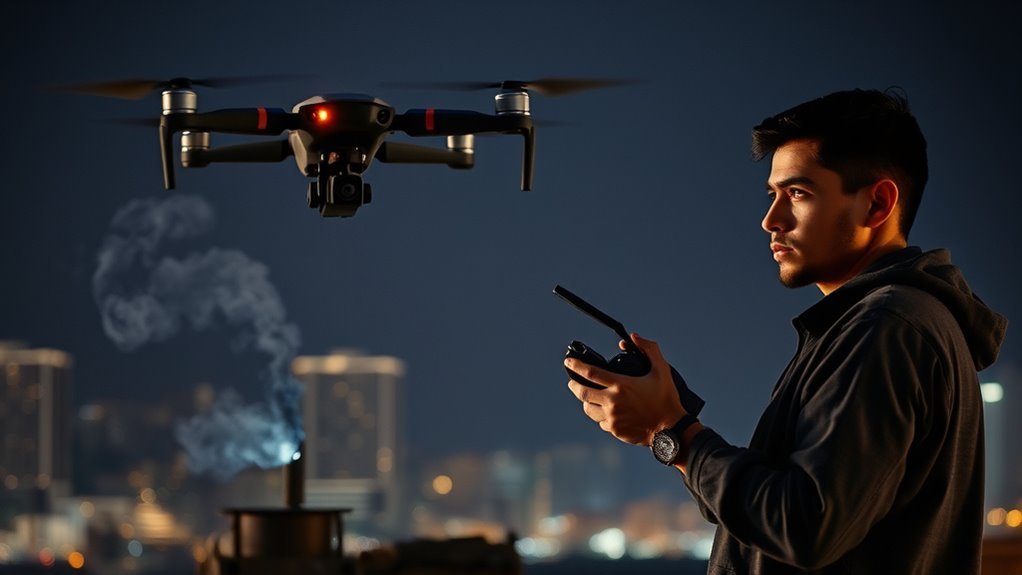
How do you begin when faced with an unidentified drone? Start by establishing situational awareness: note the drone’s altitude, flight path, and any markings or lights. Your primary goal is precise drone identification to determine potential threats or benign presence. Use visual tools or drone detection apps to gather data on the model, operator signals, and GPS coordinates if available. Document the drone’s behavior—hovering, circling, or direct approach—to assess intent. Maintain a clear, methodical approach; avoid rash decisions that jeopardize your safety or freedoms. Accurate identification guarantees you understand whether the drone infringes on privacy or airspace, empowering you to respond effectively while protecting your rights. This foundational assessment is critical before considering any further action.
Understand the Legal Implications
Before taking any action, you need to review local drone regulations to guarantee compliance with the law. Unauthorized interference with a drone can result in significant legal consequences, including fines and criminal charges. Understanding these rules helps you avoid unintended violations and protects your rights.
Local Drone Regulations
Although you might feel compelled to act quickly, it’s crucial to understand the local drone regulations that govern your area before attempting to take down a drone. Drone registration requirements and airspace restrictions vary widely, impacting what actions you can legally take. Here’s a concise reference:
| Regulation Aspect | Description | Your Responsibility |
|---|---|---|
| Drone Registration | Mandatory for drones over certain weight | Verify if the drone is registered |
| Airspace Restrictions | Zones with flight prohibitions or altitude limits | Identify if drone operates in restricted airspace |
| Local Ordinances | City or state-specific drone laws | Research applicable local rules |
Before engaging, verify you’ve assessed these factors carefully to remain within legal bounds while protecting your freedom.
Consequences of Unauthorized Actions
Understanding local drone regulations is only part of the equation when dealing with unauthorized drone activity. You must also recognize the legal repercussions that come with taking matters into your own hands. Interfering with or disabling a drone without explicit permission can lead to fines, criminal charges, or civil liability. Beyond legal risks, ethical considerations demand respect for property rights and privacy. Acting impulsively might compromise your freedom rather than protect it. Instead, methodically document the incident and report it to appropriate authorities. Balancing your desire for autonomy with adherence to lawful procedures guarantees you avoid unintended consequences. Always prioritize measured responses over unauthorized actions to maintain both your rights and legal standing. Understanding these implications safeguards you while addressing drone intrusions responsibly.
Contact Relevant Authorities
When you encounter a drone that requires intervention, you’ll need to promptly notify the relevant authorities to secure legal compliance and safety. Start by identifying the correct emergency contacts—local law enforcement, aviation authorities, or specialized drone response units. Follow established reporting procedures meticulously: provide exact location coordinates, drone description, and behavior observed. Ascertain your communication is clear, factual, and concise to facilitate swift response. Document all interactions and keep a record of your report. This methodical approach empowers you to act within legal frameworks while protecting your freedoms. Avoid unilateral actions that may breach regulations; instead, rely on authorized entities trained to handle such incidents effectively. By adhering to these protocols, you contribute to a safer environment without compromising your rights.
Use Signal Jammers or GPS Spoofing Devices
If you need to disrupt a drone’s operation directly, using signal jammers or GPS spoofing devices can effectively interfere with its communication and navigation systems. Signal interference techniques work by emitting radio frequencies that block the drone’s control signals, forcing it to either hover, land, or return to its origin. GPS manipulation strategies involve broadcasting counterfeit satellite signals to mislead the drone’s navigation system, causing it to deviate from its intended path or lose positional accuracy. When deploying these methods, verify you understand the frequency bands in use and comply with local regulations to avoid unintended consequences. Mastering these technical approaches empowers you to regain control over your airspace while protecting your freedoms without resorting to physical confrontation.
Employ Physical Methods to Capture or Disable
You can employ physical methods like net guns to safely intercept and capture drones mid-flight. Mastering drone interception techniques requires understanding flight patterns and timing to minimize risk. Always prioritize manual capture safety to prevent injury and avoid damaging the drone or surrounding property.
Net Guns Usage
Two primary factors make net guns effective tools for capturing drones: their ability to entangle rotors quickly and their portability for rapid deployment. Understanding net gun mechanics is crucial. These devices launch a compact net that expands mid-air to immobilize the drone’s propellers, halting flight without collateral damage. Precision in target acquisition guarantees a successful capture. To maximize effectiveness, follow these steps:
- Align the net gun with the drone’s predicted flight path to optimize net spread.
- Deploy the net at close to mid-range distance to balance accuracy and coverage.
- Maintain steady aim and anticipate drone maneuvers to prevent evasive actions.
Using net guns preserves your freedom to neutralize threats while minimizing risk to bystanders and property.
Drone Interception Techniques
Although electronic countermeasures are common, physical interception techniques remain vital for capturing or disabling drones when signal disruption isn’t feasible. Understanding drone technology helps you select the best interception methods for your situation. Physical tactics provide direct control over the drone, significant when preserving freedom from unauthorized surveillance or interference.
| Method | Description | Pros |
|---|---|---|
| Net Gun | Fires a net to entangle drone | Quick, reusable |
| Drone Jammer | Blocks control signals | Non-destructive, remote |
| Drone Catcher | Another drone equipped with nets | Precise, mobile |
| Projectile | Disables drone mechanically | Effective at range |
| Tether Hook | Hooks drone to reel it in | Controlled retrieval |
Choose methods based on environment, drone size, and mission constraints for effective interception.
Manual Capture Safety
When engaging in manual capture of a drone, safety must be prioritized to prevent injury and equipment damage. Employing manual capture techniques requires strict adherence to safety precautions to maintain control and avoid harm.
- Assess the drone’s speed and trajectory – Approach only when the drone slows or hovers steadily, minimizing sudden movements that could cause collisions.
- Use protective gear – Gloves and eye protection reduce risks from spinning rotors or unexpected drone reactions during capture.
- Secure the drone firmly but gently – Avoid excessive force that might damage internal components; control the drone’s descent to prevent crashes.
Utilize Trained Birds of Prey
If you’re looking for an effective and unconventional method to neutralize drones, trained birds of prey offer a precise solution. Utilizing falconry techniques, you can deploy raptors trained through disciplined bird training to intercept and disable unauthorized drones mid-flight. This approach requires methodical preparation: selecting the right species—typically hawks or falcons—followed by rigorous conditioning to respond reliably on command. The bird’s natural agility and keen eyesight make it adept at tracking and capturing drones, ensuring minimal collateral damage. You must adhere to legal and ethical guidelines governing wildlife use, ensuring the birds’ welfare throughout operations. By mastering falconry techniques, you gain a sustainable, low-tech defense tool that preserves your freedom against intrusive drone activity while embracing nature’s own precision.
Implement Drone Detection Systems
Since unauthorized drones can pose significant security risks, implementing drone detection systems is essential for timely identification and response. You need to leverage cutting-edge drone technology combined with advanced detection algorithms to monitor and identify aerial threats effectively. Begin by:
Implement drone detection systems to identify and respond swiftly to unauthorized aerial threats.
- Deploying multi-sensor arrays—including radar, acoustic, and radio frequency detectors—to capture varied drone signatures.
- Integrating real-time detection algorithms that analyze sensor data for accurate drone classification and trajectory prediction.
- Establishing automated alert protocols that notify you immediately upon detecting unauthorized drone activity.
Establish Preventative Measures and No-Fly Zones
Building on the capabilities provided by drone detection systems, you must establish preventative measures and clearly defined no-fly zones to proactively reduce unauthorized drone incursions. Start by mapping sensitive areas requiring protection, such as government buildings or private properties, and designate them as no fly zones with precise GPS coordinates. Employ geofencing technology to enforce these zones, automatically restricting drone operations within designated boundaries. Implement signage and public notifications to inform drone operators of restricted airspace. Combine these preventative measures with regulatory frameworks and real-time monitoring to deter violations effectively. By integrating technology and policy, you create a robust barrier against unauthorized drone flights, ensuring your airspace remains secure while respecting the freedoms of compliant drone users. This systematic approach balances control with liberty, empowering you to maintain order without unnecessary restrictions.
