

DJI stands for Da-Jiang Innovations, a name that reflects their focus on pushing boundaries in drone technology. Founded in 2006 by Frank Wang, DJI pioneered advanced flight control systems and compact designs that transformed drones into reliable, user-friendly tools for creators and professionals alike. Their innovations reshaped multiple industries with professional-grade capabilities accessible to consumers. If you want to grasp how DJI’s vision and technology have revolutionized aerial devices, there’s much more to uncover.
The Origin of DJI
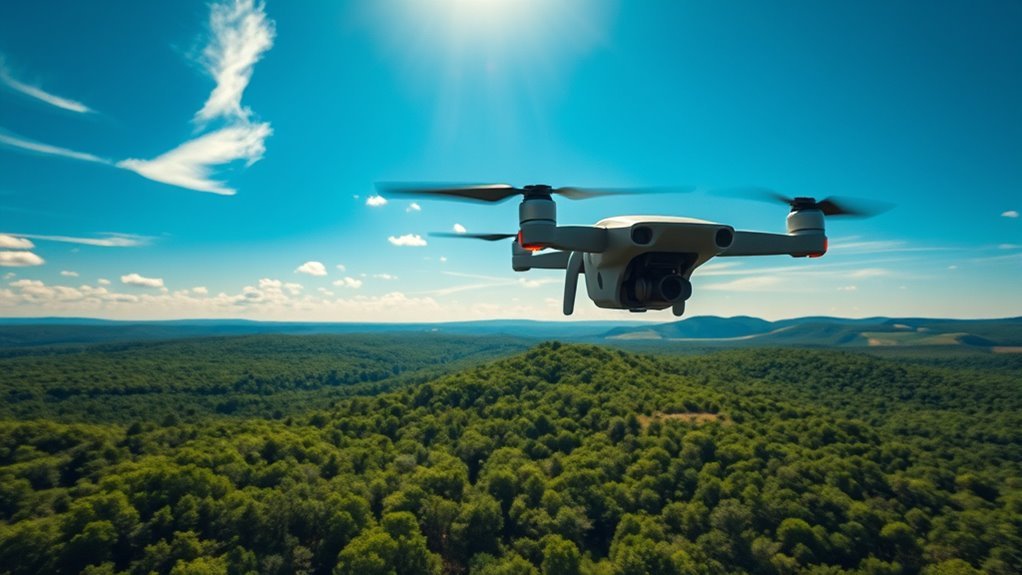
DJI’s origin traces back to 2006 when Frank Wang founded the company in Shenzhen, China. Understanding DJI history reveals how this startup rapidly evolved from a small team into a global leader in drone technology. When you examine drone origins, you see DJI’s innovative approach to integrating advanced flight control systems with compact design. This technical mastery granted users unprecedented freedom to capture aerial perspectives previously inaccessible. You’ll appreciate how DJI’s development focused on creating reliable, user-friendly platforms that empower creative and professional endeavors alike. By mastering embedded systems and sensor fusion, DJI pioneered the commercialization of drones, setting industry standards. Knowing this foundation helps you grasp why DJI remains synonymous with quality and innovation, enabling you to explore and expand your aerial capabilities safely and effectively.
Breaking Down the DJI Acronym

The acronym DJI stands for Da-Jiang Innovations, reflecting the company’s roots and mission. When you explore drones explained, understanding the acronym significance becomes essential. DJI isn’t just a name; it embodies a philosophy of innovation and freedom in aerial technology.
Here’s what you should note:
- Da-Jiang (大疆) translates to “Great Frontier,” symbolizing pushing boundaries.
- Innovations highlights their commitment to cutting-edge drone technology.
- The acronym reflects a blend of cultural heritage and futuristic vision.
DJI’s Founder and Early Beginnings
Although many know DJI for its advanced drones today, you might be surprised to learn it was founded by Frank Wang in 2006 while he was still a university student in Shenzhen. The founder’s vision was clear: to empower individuals with freedom through innovative technology. Despite early challenges like limited resources and technical hurdles, Wang’s determination propelled DJI forward. Understanding these beginnings helps you appreciate the resilience behind each drone.
| Aspect | Emotion Evoked |
|---|---|
| Founder’s Vision | Inspiration |
| Early Challenges | Respect |
| Student Startup | Admiration |
| Innovation Drive | Hope |
| Empowering Freedom | Motivation |
You can see how these factors shaped DJI’s journey from a small dorm room project to a global leader in drone technology.
How DJI Revolutionized Drone Technology
From those humble beginnings, DJI quickly set new standards in drone technology by pushing the limits of flight stability, camera integration, and user control systems. If you want to experience true freedom in aerial photography, DJI’s innovations are what make it possible. Their drone advancements enable you to capture smooth, high-resolution footage effortlessly. Key breakthroughs include:
DJI revolutionizes aerial photography with unmatched flight stability, integrated cameras, and intuitive controls for effortless, high-quality footage.
- Advanced flight stabilization algorithms that keep your drone steady in challenging conditions.
- Seamless integration of professional-grade cameras, allowing you to shoot cinematic visuals from the sky.
- Intuitive user control interfaces, giving you precise command and creative flexibility.
These technological leaps transformed drones from niche gadgets into indispensable tools for creators and explorers. When you choose DJI, you’re not just flying; you’re redefining what aerial freedom means.
Key Products That Defined DJI’s Success
When you explore DJI’s product lineup, you’ll find a series of groundbreaking devices that set industry benchmarks and redefined aerial technology. DJI drones and DJI accessories have become synonymous with reliability, innovation, and user freedom, empowering you to capture and explore like never before.
| Product | Significance |
|---|---|
| Phantom Series | Revolutionized consumer drones |
| Mavic Series | Portable, foldable, high-performance |
| Inspire Series | Professional-grade cinematography |
| Ronin Gimbals | Stabilization for dynamic filming |
Each product offers unique capabilities, whether it’s the Mavic’s portability or the Inspire’s professional-grade imaging. DJI accessories further enhance your experience, providing modularity and expanded functionality. This product ecosystem doesn’t just meet your expectations—it liberates your creativity and control in the skies.
The Impact of DJI on Consumer and Professional Markets
Numerous industries have been transformed by DJI’s innovations, which bridge the gap between consumer accessibility and professional-grade technology. When you engage with DJI’s products, you’re tapping into a powerful ecosystem that supports both hobbyists and industry experts alike. Their impact is evident across:
- Film and media production, where precise aerial footage meets user-friendly controls.
- Agriculture, enabling crop monitoring with advanced sensors previously limited to experts.
- Public safety and infrastructure inspection, providing reliable data collection tools accessible to non-specialists.
Future Innovations and What to Expect From DJI
As DJI continues to push the boundaries of drone technology, you can expect advancements that enhance autonomy, sensor integration, and AI-driven analytics. These future trends will empower you with unprecedented control and insight, expanding the freedom drones offer.
| Aspect | Future Trends | Technological Advancements |
|---|---|---|
| Autonomy | Fully autonomous flight | AI-powered obstacle avoidance |
| Sensor Integration | Multispectral and thermal | Enhanced environmental sensors |
| Data Analytics | Real-time AI processing | Predictive maintenance |
| Connectivity | 5G and mesh networking | Low-latency data transmission |
| Design | Lightweight, modular builds | Advanced battery tech |
