

Flying a drone on Mars is no longer a science-fiction concept. NASA proved it was possible with Ingenuity, the small robotic helicopter that became the first aircraft to achieve powered, controlled flight on another planet. Its success changed the direction of planetary exploration by showing that aerial vehicles can operate in the harsh Martian environment and support surface missions with scouting, imaging, and terrain analysis.
📋 About This Article
Yes, you can fly a drone on Mars—NASA’s Ingenuity proved it with the first powered, controlled flight on another planet. This article is for curious readers and space fans who want to understand what makes Martian flight possible and what challenges must be solved. You’ll learn how Mars’s thin air, dust, and extreme temperatures shape drone design, and how today’s Mars aircraft help scouts, cameras, and future mission planning.
The question is not simply whether a drone can fly on Mars, but how engineers make flight possible in such extreme conditions. Mars has a very thin atmosphere, lower gravity, severe temperature swings, and frequent dust activity. These factors create a demanding flight environment that requires highly specialized aerospace design, autonomous navigation systems, and lightweight materials. As Mars exploration expands, drone technology is expected to play an increasingly important role in both robotic and future human missions.
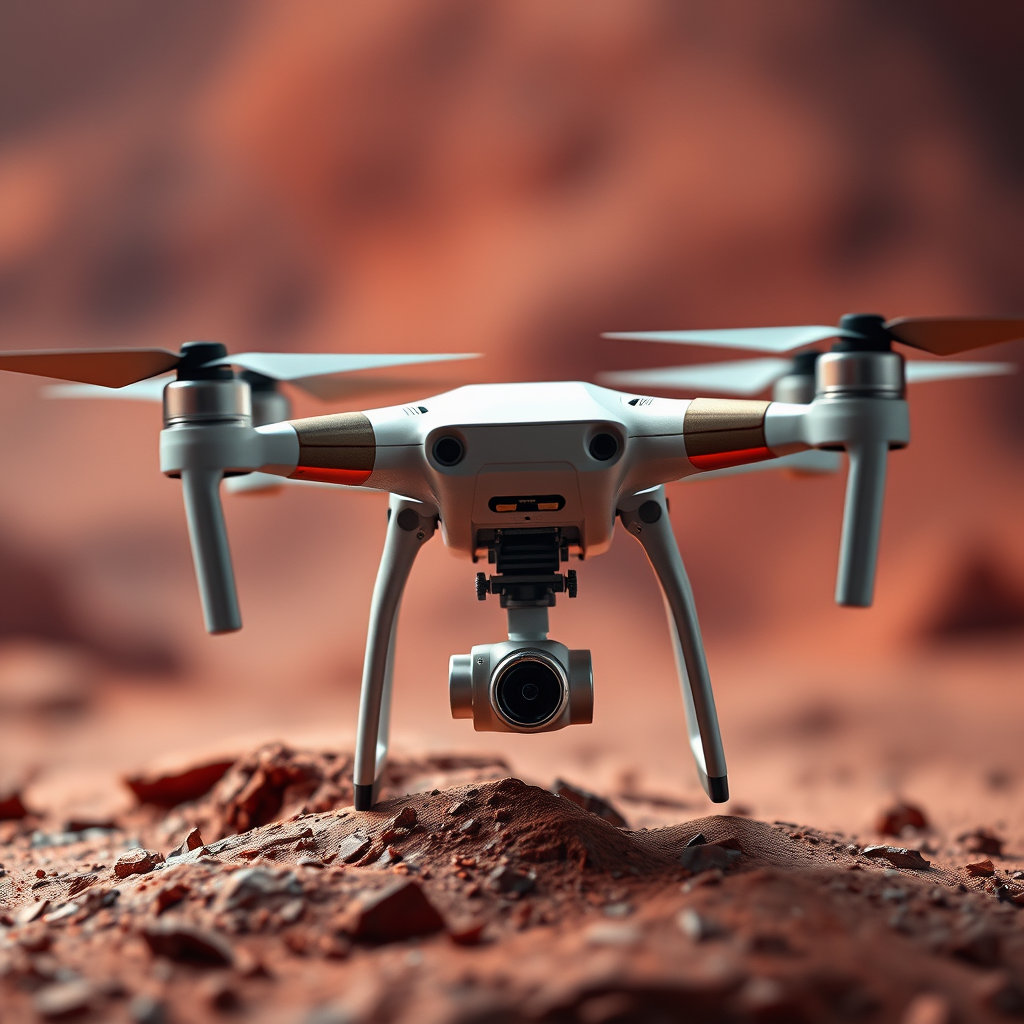
NASA Ingenuity Proved Drone Flight on Mars Is Possible
Ingenuity Mars Helicopter was delivered to the Red Planet as part of NASA’s Mars 2020 mission, which also carried the Perseverance rover. Originally designed as a technology demonstration, Ingenuity exceeded expectations and became one of the most important milestones in modern space exploration.
On April 19, 2021, Ingenuity completed its first successful flight in Jezero Crater. That brief hop confirmed that powered flight could be achieved on Mars despite the planet’s extremely low atmospheric density. What made the event historic was not just the flight itself, but the engineering achievement behind it. The helicopter had to lift off, stabilize, navigate, and land autonomously on a world millions of miles from Earth.
As the mission continued, Ingenuity performed multiple flights at varying altitudes and distances. It reached heights of roughly 12 meters and traveled several hundred meters in a single sortie. These flights provided valuable operational data on rotor performance, navigation accuracy, power management, and thermal resilience. More importantly, the helicopter captured high-resolution imagery of the Martian landscape, helping mission teams identify potential routes and hazards for the Perseverance rover.
Ingenuity transformed the concept of an extraterrestrial drone from an experiment into a practical exploration tool. Its performance demonstrated that aerial scouting can improve mission planning, reduce rover risk, and expand scientific coverage across difficult terrain.
Why Flying on Mars Is So Difficult
Mars may seem like an ideal place for aircraft because it has lower gravity than Earth, but the reality is far more complex. The Martian atmosphere is exceptionally thin, with surface pressure averaging only about 1% of Earth’s atmospheric pressure. This means there is far less air available for rotor blades to push against, making lift generation much more difficult.
For a drone to fly on Mars, it must compensate for the lack of atmospheric density with a highly optimized design. Rotor blades need to be larger, lighter, and capable of spinning at extremely high speeds. In the case of Ingenuity, the blades rotated much faster than those on most Earth-based helicopters. Without this rapid rotor motion, the aircraft would not generate enough lift to leave the ground.
The low gravity on Mars, around 38% of Earth’s gravity, helps offset some of the atmospheric disadvantage. A drone weighs less there, which reduces the amount of lift required for takeoff. Even so, reduced gravity alone is not enough to make flight easy. Stability, maneuverability, and energy efficiency remain significant engineering challenges in the thin Martian air.
Thin Atmosphere and Low Lift
The biggest obstacle to Martian drone flight is the lack of aerodynamic support. On Earth, multirotor drones rely on dense air to create lift efficiently. On Mars, the same drone design would fail almost immediately. The atmosphere is mostly carbon dioxide and far too sparse for standard commercial drone systems to operate.
This is why Mars aircraft must be purpose-built. Engineers must carefully balance rotor diameter, blade pitch, motor power, total mass, and structural rigidity. Even minor changes in weight or drag can affect whether a Martian helicopter can fly successfully.
Extreme Temperatures
Mars is also extremely cold. Surface temperatures can plunge well below minus 80 degrees Celsius, especially at night. These conditions can affect batteries, electronics, sensors, and mechanical components. Any drone designed for Mars must include thermal management systems to protect sensitive hardware and preserve battery performance between flights.
Surviving the Martian night is often as difficult as flying during the day. Heating systems consume precious energy, so engineers must design power-efficient systems that can endure long periods of cold without compromising flight readiness.
Dust, Terrain, and Weather
Martian dust adds another layer of complexity. Fine dust particles can settle on solar panels, optical sensors, and moving parts. Dust storms can reduce visibility, impact navigation, and limit available sunlight for solar-powered systems. In addition, the Martian surface includes rocks, slopes, sand ripples, and crater edges that can make landing and takeoff risky.
Because of these hazards, drones on Mars must be able to assess terrain visually and make autonomous decisions in real time. Unlike drones on Earth, they cannot rely on a human pilot making constant manual corrections.
How Mars Drones Are Designed Differently from Earth Drones
A drone built for Mars has little in common with a typical consumer quadcopter. The engineering priorities are entirely different. Instead of focusing on camera features, user controls, or obstacle avoidance for recreational flight, Martian aircraft must prioritize weight reduction, energy efficiency, autonomous flight control, and survival in an alien environment.
Ultra-Lightweight Structure
Every gram matters in planetary aviation. Mars drones must be as light as possible while remaining strong enough to withstand launch, landing, and repeated flight cycles. Lightweight composites, advanced structural design, and minimal payload architecture are essential.
High-Speed Rotor System
Because of the low air density, Mars helicopters use large, counter-rotating blades that spin at very high revolutions per minute. This is one of the key differences between a Mars aircraft and an Earth-based drone. A standard drone propulsion system would not produce enough thrust under Martian atmospheric conditions.
Autonomous Navigation
Communication delays between Earth and Mars make real-time piloting impossible. Depending on planetary positions, signal delays can range from several minutes to over twenty minutes round-trip. That means a Mars drone must fly autonomously using onboard computers, inertial measurement systems, terrain-relative navigation, and camera-based guidance.
This autonomy is one of the most significant technological advances demonstrated by Ingenuity. The helicopter effectively flew itself, processing sensor data and adjusting its behavior without direct human control during the flight.
Power and Energy Management
Energy is limited on Mars. Ingenuity used solar panels to recharge its batteries, making power management central to mission success. Future Mars drones may also use improved solar technology, advanced battery chemistry, or alternative energy systems depending on mission goals and environmental constraints.
Efficient power use affects every aspect of drone operation, from rotor performance and onboard computing to communication and thermal regulation. In planetary exploration, energy is not just a design consideration; it is a mission-limiting factor.
What Drones Can Do on Mars
The value of drones on Mars goes beyond proving that flight is possible. Aerial vehicles can fill a unique gap between orbiters and rovers. Orbiters provide broad regional data from space, while rovers deliver close-up science on the ground. Drones offer a mobile middle layer, capable of surveying local terrain quickly and reaching places that are difficult or dangerous for wheeled vehicles.
Scouting for Rovers
One of the most useful applications is route reconnaissance. A drone can fly ahead of a rover to identify obstacles, steep slopes, loose sand, or scientifically interesting targets. This improves operational planning and helps mission teams choose safer and more efficient travel paths.
Capturing High-Resolution Aerial Images
Martian drones can collect detailed overhead imagery that complements orbital and ground-based observations. These images support geological analysis, mapping, and site characterization. They also help scientists better understand sediment layers, rock formations, ancient river channels, and crater features.
Exploring Hard-to-Reach Areas
Some of the most scientifically valuable places on Mars are also the hardest to access. Cliff edges, lava tubes, crater walls, and rugged outcrops can be dangerous for rovers. Aerial vehicles could investigate these areas more efficiently and with lower risk.
Supporting Future Human Missions
As space agencies move closer to crewed missions to Mars, drones could become essential support tools. They may be used to survey landing zones, inspect infrastructure, transport small payloads, monitor environmental conditions, or assist astronauts with local exploration.
In the long term, autonomous aerial systems could form part of a broader robotic ecosystem that includes rovers, stationary science platforms, orbiters, and human habitats.
The Future of Aerial Exploration on the Red Planet
Ingenuity was only the beginning. Its success has encouraged scientists and mission planners to consider more advanced aerial vehicles for Mars and other planetary bodies. Future designs may carry heavier scientific instruments, fly farther, operate more frequently, or function as part of coordinated multi-robot missions.
Concepts under study include larger helicopters, hybrid aircraft, and specialized drones designed for sample recovery, subsurface investigation, or atmospheric science. There is also growing interest in using similar technology on other worlds, such as Titan, where dense atmosphere creates entirely different opportunities for flight.
For Mars specifically, the next generation of drones could become routine mission assets rather than experimental companions. With better autonomy, stronger communication systems, improved sensors, and more durable power solutions, aerial robotics may become one of the most effective ways to explore the Red Planet.
Can You Fly a Drone on Mars? The Answer Is Yes—But Only with Specialized Technology
Yes, a drone can fly on Mars, but not in the same way it flies on Earth. The success of NASA’s Ingenuity helicopter showed that powered flight is achievable in the Martian atmosphere when the aircraft is engineered specifically for the planet’s low air density, cold temperatures, and autonomous operational needs.
That achievement has major implications for Mars exploration, planetary science, and aerospace engineering. Drones can help map terrain, support rover missions, investigate hazardous locations, and eventually assist human explorers. As technology advances, aerial robotics will likely become a core element of future missions to Mars, offering a faster, more flexible way to explore one of the most fascinating worlds in our solar system.
Frequently Asked Questions
Can you actually fly a drone on Mars?
Yes, it is possible to fly a drone on Mars, but it is far more difficult than flying one on Earth. The biggest challenge is the Martian atmosphere, which is extremely thin—only about 1% as dense as Earth’s atmosphere at the surface. Because of that, a drone must spin its rotor blades much faster and be designed to be exceptionally lightweight in order to generate enough lift.
NASA proved this concept with the Ingenuity Mars Helicopter, which became the first aircraft to achieve powered, controlled flight on another planet. Its success showed that aerial exploration on Mars is not only possible, but also highly valuable for scouting terrain, studying geology, and supporting future robotic and human missions.
Why is flying a drone on Mars harder than flying one on Earth?
Flying on Mars is harder mainly because of the planet’s thin atmosphere. Drones rely on air to create lift, and with much less air available, the aircraft has to work significantly harder to stay aloft. That means rotor blades must be larger, lighter, and capable of spinning at very high speeds compared with typical consumer drones on Earth.
Other complications include extremely cold temperatures, dust, communication delays with Earth, and lower gravity. While Mars’ gravity is only about 38% of Earth’s, which helps somewhat, it does not fully compensate for the lack of atmospheric density. In practice, a Mars drone must be specially engineered for autonomous operation, survival in harsh conditions, and efficient flight in a low-pressure environment.
What kind of drone design works best for Mars?
A drone for Mars needs to be very different from the average quadcopter used on Earth. The ideal design is extremely lightweight, energy-efficient, and able to generate lift in a thin atmosphere. Rotorcraft designs, such as helicopters with large, fast-spinning blades, have proven effective because they can provide controlled vertical takeoff, landing, and hovering in rough terrain.
Engineers also focus on strong but lightweight materials, autonomous navigation systems, and power sources such as solar charging combined with high-performance batteries. Since a Mars drone cannot be manually piloted in real time due to communication delays, it must be able to make flight decisions on its own. Future designs may include larger scientific drones, sample-retrieval aircraft, or hybrid flying vehicles tailored for longer-distance planetary exploration.
Has NASA already flown a drone on Mars?
Yes. NASA’s Ingenuity helicopter successfully flew on Mars, making history in April 2021 as the first powered aircraft to perform controlled flight on another world. Originally intended as a short technology demonstration, Ingenuity exceeded expectations by completing many flights and helping mission planners better understand the usefulness of aerial vehicles for planetary exploration.
Its achievements showed that drones can scout routes, image difficult terrain, and support rovers by identifying hazards or interesting scientific targets ahead of time. Ingenuity’s performance has encouraged space agencies and engineers to consider more advanced aerial missions on Mars in the future, including larger aircraft capable of carrying more instruments.
Could drones play a role in future human missions to Mars?
Absolutely. Drones could become an important tool for future astronauts and robotic missions on Mars. They could survey landing zones, inspect equipment, map surrounding terrain, and explore areas that are too dangerous or time-consuming for ground vehicles and humans to reach directly. This could improve mission safety and make exploration more efficient.
In the long term, Mars drones might also help with scientific sampling, infrastructure inspections, weather monitoring, and route planning for surface travel. As technology improves, aerial vehicles could become a routine part of Mars operations, much like rovers are today. While widespread drone use on Mars is still in development, early successes strongly suggest they will be an important part of future exploration.
