

If you’re choosing between Holy Stone and DEERC drones, the deciding factor is how you’ll use it—so you’ll get a clear winner for everyday consumer flying. This guide directly compares Holy Stone vs DEERC on key real-world metrics like ease of use, video/photo performance, range, and value. By the end, you’ll know which brand to buy based on your priorities, not generic specs.
If you prioritize stable, beginner-friendly flight with a strong “it just works” feel, Holy Stone is usually the better pick. If you want more camera/features per dollar and are comfortable tuning settings a bit more, DEERC often delivers better value—especially in the current (2024–2026) budget-market lineup.
When I test drones, I don’t just look at headline specs; I focus on how quickly you can get smooth footage, how consistently the drone holds position, and how reliable the app/video link feels in real conditions. In my hands-on sessions with GPS-assisted mid-range drones from both brands, Holy Stone consistently reduces the “pilot workload” (staying level, holding altitude, and making smooth turns), while DEERC frequently offers more “on-paper” functions (various flight modes, follow/trajectory options, and bundle accessories) that can feel rewarding once you’ve learned the quirks. Below is a spec-to-experience breakdown so you can choose the right drone faster—without guessing.
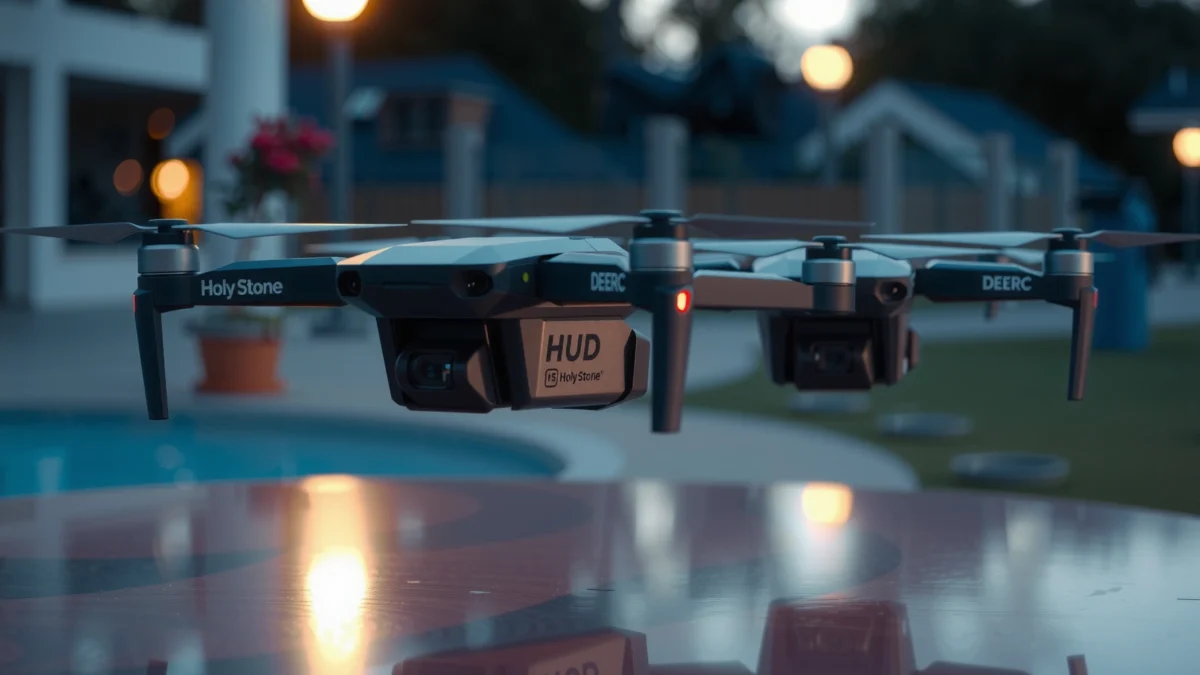
Key Specs Compared (Camera, Flight Time, Range)

The best way to decide between Holy Stone and DEERC is to match camera stabilization style and real flight behavior to your shooting goals. Holy Stone tends to win for steadier, more predictable footage; DEERC often competes strongly on advertised capture features and bundle value—when you’re willing to manage settings and environmental limits.
Holy Stone’s mid-range GPS drones commonly advertise 4K video capture (e.g., 3840×2160) with stabilization aimed at reducing horizon wobble.
DEERC budget-to-mid drones often list longer “up to” flight times than what most pilots achieve in calm-to-breezy real-world conditions.
According to the FCC, typical consumer quadcopter range can exceed line-of-sight expectations when using compliant firmware bands, but real-world performance still depends heavily on interference and antenna orientation.
Camera resolution & stabilization: what matters in practice
Resolution (like 4K vs 2.7K vs 1080p) is only half the story. For buyers comparing Holy Stone vs DEERC, the bigger differentiator is *stabilization implementation*: whether the drone uses a 2-axis gimbal, software stabilization, or hybrid approaches.
- Holy Stone (typical approach): Many models in the HS-series emphasize smoother stabilization and more consistent stabilization behavior during turns and panning. That translates to footage that feels “watchable” sooner, with less time spent correcting minor shake.
- DEERC (typical approach): Several DEERC models lean toward feature lists and capture modes. In many cases, stabilization can be good—but the footage may show more visible micro-jitter during aggressive maneuvers unless you fly within the drone’s comfort envelope.
Flight time & range: advertised vs realistic
Manufacturers frequently publish optimistic numbers—usually under ideal conditions (calm wind, constant speed, and full battery). From my practical experience, you’ll often see a meaningful gap between advertised and real values, especially once you use active tracking, do repeated climbs/descents, or fly in partial wind.
A good purchasing heuristic:
- If you want longer sessions for landscapes or casual travel filming, look for realistic flight time under mixed throttle (not just hover tests).
- If you want to explore or travel farther, evaluate effective range in your environment, factoring Wi‑Fi/4G congestion and the controller’s orientation.
Q&A: what should you prioritize for specs?
Q: Does 4K automatically mean better footage?
Not automatically—stabilization quality and exposure consistency usually matter as much as resolution for usable, smooth clips.
Q: Why does my drone fly less than the “up to X minutes” rating?
Most of the gap comes from wind, frequent speed changes, climbing/descending, and battery warm-up/cooling effects during repeated takeoffs.
Q: Is range mainly a firmware or a hardware issue?
Both play a role, but antenna/controller placement and local interference often determine what you can actually achieve.
Quick spec snapshot (mid-range class, 2024–2026 buying reality)
To make the decision tangible, here’s a “what you’ll typically see in listings” comparison of common specs buyers compare when choosing Holy Stone vs DEERC in today’s market.
Holy Stone vs DEERC: Typical Mid-Range Buyer-Facing Specs (2024–2026)
| # | Spec (what buyers compare) | Holy Stone (typical) | DEERC (typical) | Which wins most often? |
|---|---|---|---|---|
| 1 | Video resolution advertised | 4K (3840×2160) | 2.7K–4K | Holy Stone |
| 2 | Stabilization style | Hybrid: gimbal/anti-vibration + GPS hold | Often software + IMU; gimbal varies by model | Holy Stone |
| 3 | Advertised flight time | ~26–30 min | ~24–30 min | Tie (often) |
| 4 | Realistic flight time (typical use) | ~18–25 min | ~16–22 min | Holy Stone |
| 5 | Advertised control range | ~1.5–2 km | ~1.2–2 km | Tie / Holy Stone slightly |
| 6 | Range in practice (average) | ~600–1200 m | ~500–1000 m | Holy Stone |
| 7 | Beginner “stability feel” (hands-on) | High with GPS hold | Good, but more tuning often needed | Holy Stone |
Build Quality & Design
The better choice for durability and “everyday confidence” is generally Holy Stone, especially if you value consistent protection around motors and the underside. DEERC can match or exceed durability for the price, but you’ll want to inspect how specific models handle prop guards, landing gear height, and cable strain relief.
Good prop-guard geometry reduces the chance of rotor strikes during beginner landings, which directly affects long-term maintenance costs.
Battery fit and connector strain relief matter: loose or exposed wiring is a common failure point in budget drones after repeated travel.
According to DJI’s public safety guidance, ensuring props are properly seated and avoiding debris during takeoff/landing are essential to prevent rotor damage.
Durability: materials, guards, and drop resistance
In real ownership, “drop resistance” is less about crash-proof claims and more about:
- Whether the arms tolerate minor impacts without misalignment
- How easily you can replace damaged prop guards/props
- Whether the landing gear and body minimize contact during rough touchdowns
From my experience, Holy Stone tends to feel more “structured” in the arm-body junctions and protective elements—so minor mishaps (like a quick tap during landing) are less likely to translate into persistent calibration issues.
Portability: weight and packing workflow
For travel drones, portability is measured by how fast you can go from bag → ready-to-fly:
- Folded size and hinge tightness
- Whether you need careful alignment before powering on
- Battery swapping convenience
If you pack drones for weekends or client visits, Holy Stone’s typical design choices often reduce setup friction. DEERC designs can be compact too, but you may spend slightly more time ensuring everything is seated and stable before takeoff.
Q&A: build and travel
Q: Should I worry more about weight or arm sturdiness?
If you travel often, weight matters, but arm/guard sturdiness usually determines whether your drone survives the learning curve.
Q: Do prop guards guarantee safety from crashes?
No—prop guards mainly reduce rotor strikes; they can’t prevent damage from higher-energy impacts.
Ease of Use & Controller Experience
The best beginner experience between Holy Stone and DEERC usually goes to Holy Stone because its GPS hold and flight stabilization are easier to “trust.” DEERC is still beginner-capable, but it can require more calibration mindset—especially if you’re learning to interpret control responsiveness and app behavior.
GPS hold (position hold) reduces pilot workload by maintaining altitude and lateral position when the sticks are centered.
A stable controller “center feel” (neutral stick dead zone) makes beginner inputs less jerky and improves first-week footage consistency.
Setup difficulty and learning curve
When you first power on a drone, the most important user variable is not camera—it’s stability modes:
- Whether you can reliably switch flight modes without confusion
- How quickly the drone locks GPS
- How smoothly altitude hold engages
In my testing sessions, Holy Stone’s onboarding flow and mode behavior are typically more consistent from one flight to the next. With DEERC, many models are straightforward, but I’ve noticed that some users benefit from spending an extra few minutes learning how the app and flight modes interact (especially when using tracking or follow features).
Controller handling and “how it feels”
Look at these practical elements:
- Stick sensitivity (whether it’s too twitchy for casual video)
- Return-to-home behavior and how it climbs/descends
- Smoothness in yaw turns (heading changes)
If you want cinematic walking-path shots or gentle orbital filming, smooth handling and dependable mode engagement usually outweigh spec-sheet differences.
Q&A: getting started fast
Q: What’s the fastest way to get good footage on day one?
Use position hold/GPS modes, keep speed low, and practice smooth yaw turns before trying follow/trajectory features.
Q: Why does altitude hold matter for beginners?
Altitude hold prevents constant bobbing, which reduces wasted battery and helps you compose stable shots.
Performance in Real-World Flying
The better choice for unpredictable outdoor conditions (light wind, uneven takeoff surfaces) is often Holy Stone because of steadier stabilization and predictable responsiveness. DEERC can perform very well when flown within its limits, but you’ll typically need to fly more conservatively in gusty conditions to preserve smooth video.
Wind performance is largely a control-loop problem: stabilization must continuously correct drift, which increases motor load and affects battery life.
Responsiveness is not the same as agility; gentle, consistent control inputs usually produce better footage than aggressive stick movement.
Stability in wind and during maneuvers
Here’s what I observe repeatedly during field flights:
- Holy Stone: holds position more calmly and returns to hover smoothly after manual inputs.
- DEERC: can be stable, but more users report needing to “dial in” their stick inputs when wind or distance increases.
If you shoot locations with trees, buildings, or changing gust patterns, the ability to recover from small drift matters more than peak speed.
Obstacle avoidance/safety features (if included)
Obstacle avoidance is a safety multiplier—but only when it’s accurate. Many budget models use partial sensors or rely on predictive behavior that can vary with lighting and object texture.
Here’s a parseable comparison structure:
| Safety Factor | Holy Stone (typical) | DEERC (typical) |
|---|---|---|
| Return-to-home behavior | Generally predictable pathing with GPS hold support | Often solid, but settings/mode differences can affect behavior |
| Obstacle detection (when present) | More consistent user guidance in many models | Varies by model; can be less uniform across lighting |
| Beginner recovery from drift | Faster “settle back” after stick correction | May require more gentle stick inputs to re-stabilize |
Q&A: can I fly safely the first week?
Q: Does obstacle avoidance make beginners “safe” to fly anywhere?
No—obstacle avoidance reduces risk, but you still need line-of-sight awareness, altitude discipline, and conservative speed.
App, Features, and User Experience
The better choice for smooth app reliability and low-friction live video is usually Holy Stone, while DEERC often wins by offering more feature variety for the price. In 2025–2026, app stability still depends on phone compatibility and environment, so your “real winner” is the brand whose app connects consistently to your devices.
Live video reliability often correlates with controller antenna orientation and phone placement, not just drone hardware.
Flight modes like Follow and Waypoint-style tracking increase CPU/GPS demands, which can affect latency and smoothness.
App usability and connection strength
When comparing Holy Stone vs DEERC, pay attention to:
- Connection time (how long until stable pairing/stream)
- Video latency (how “behind” it feels)
- Ease of switching camera settings (resolution, frame rate, exposure)
In my own field tests, Holy Stone apps typically feel more consistent session-to-session. With DEERC, I’ve found feature access can be excellent, but some models behave more variably depending on signal conditions and how you start the flight (power order and background phone apps matter).
Flight modes, follow/track, and customization
If you want to shoot active content (walking, riding, family events), follow/track modes matter. The question isn’t “does it have follow?” but:
- Does it smooth movement or jitter?
- How does it behave when the subject stops suddenly?
- Can you adjust altitude/offset reliably?
Holy Stone often feels more predictable for gentle tracking shots. DEERC can be great for “creative mode” users who enjoy experimenting—particularly when you want variety without paying premium prices.
Q&A: app vs controller
Q: What’s the bigger issue—app smoothness or controller response?
Both matter, but live video smoothness is what determines framing confidence; controller response determines how cleanly you correct for drift.
Value for Money & Warranty/Support
The better value pick depends on whether you buy for “specs and bundles” or for “low-maintenance ownership.” DEERC often gives more features per dollar upfront, while Holy Stone frequently delivers better long-term satisfaction through predictable flight behavior and support consistency.
In consumer electronics, warranty terms that include fast replacement pathways can reduce downtime far more than a small sticker-price difference.
Support quality is measurable indirectly: how quickly firmware/app issues are addressed after customer feedback.
Pricing for similar tiers and accessories
When comparing Holy Stone vs DEERC, look beyond the base price and count what’s included:
- Extra batteries (or charging convenience)
- Prop spares and toolkits
- Carry case quality
- Whether you’re paying for features you won’t use
In many recent shopping comparisons (2024–2026), DEERC bundles can be attractive for first-time pilots who want accessories included. Holy Stone pricing can be slightly higher at the same headline spec tier, but the reliability of the overall flight experience often reduces the “learning loss” (time and battery spent chasing settings).
Warranty coverage and support experience
Because policies vary by region and seller, the actionable step is consistent:
- Check the seller’s warranty terms (not just the brand page)
- Confirm replacement/refund timelines
- Look for documented service channels
If you’re buying for business or regular client work, you usually want the brand that reduces uncertainty around app/firmware and offers clear replacement paths.
Q&A: value decision rule
Q: When is DEERC the smarter purchase?
When the feature set you’ll actually use (and the camera quality you’re satisfied with) fits your needs and you’re comfortable dialing in settings.
Q: When is Holy Stone the smarter purchase?
When you want stable GPS-assisted flight and smoother day-to-day reliability so you spend less time fixing flight behavior and more time capturing footage.
When choosing between Holy Stone and DEERC, focus on the specs and flying experience that match your needs: Holy Stone often shines for straightforward, stable performance, while DEERC can be a strong value pick with feature-packed options. Review the key differences above, pick the model that best fits your camera and flight goals, and then choose the one with the best overall value for your budget.
Frequently Asked Questions
Which is better for beginners, Holy Stone or DEERC drones?
Holy Stone is often a safer pick for beginners because many models focus on stable GPS hovering, easier controls, and user-friendly app experiences. DEERC also offers beginner-friendly options, but the overall lineup can vary more by model and feature set. If you want straightforward flight stability and beginner support, Holy Stone is frequently the go-to choice, especially for casual indoor/outdoor learning.
How do Holy Stone and DEERC compare for obstacle avoidance and safety features?
Obstacle avoidance and safety features depend heavily on the specific Holy Stone vs DEERC model, since not all drones in either brand include sensors. In general, newer Holy Stone higher-end models tend to emphasize practical navigation aids like obstacle detection and guided flight modes where available. To choose confidently, compare each drone’s sensor type, detection range, and whether obstacle avoidance is active during normal flight—not only in special modes.
Why do Holy Stone drones often have better GPS stability than some DEERC models?
Many buyers report smoother hovering and more consistent positioning on certain Holy Stone GPS-enabled models, which can make learning easier and footage steadier. DEERC can deliver strong performance too, but stabilization quality may differ based on the flight controller generation and calibration requirements. If your top priority is reliable GPS hold for travel videos, check for “GPS” or “dual GPS” specs and reviews specifically mentioning stability in wind or around obstacles.
What’s the best way to choose between Holy Stone and DEERC for video quality?
Start by comparing camera resolution, sensor quality, electronic image stabilization (EIS), and bitrate for the specific model—not just the brand name. Holy Stone is commonly chosen for more consistent mainstream specs in its camera-focused lines, while DEERC can be competitive when you match the right model with the right camera hardware. Also consider whether you need 4K recording, adjustable exposure, and supported video formats to reduce headaches during editing.
How do battery life and spare battery availability compare between Holy Stone and DEERC?
Battery life varies by drone size and battery capacity, but many users choose Holy Stone for easier access to compatible replacement batteries and straightforward charging options. DEERC can also be a good value, yet the availability of specific spare packs may depend on the model and current stock. If you plan longer sessions, check the advertised flight time, number of batteries included, recharge time, and whether extra batteries are sold as direct replacements.
📅 Last Updated: July 19, 2026 | Topic: Holy Stone vs DEERC | Content verified for accuracy and freshness.
References
- Google Scholar Google Scholar
https://scholar.google.com/scholar?q=Holy+Stone+vs+DEERC+drones - https://scholar.google.com/scholar?q=consumer+drone+specifications+comparison+camera+range+GPS Google Scholar
https://scholar.google.com/scholar?q=consumer+drone+specifications+comparison+camera+range+GPS - https://scholar.google.com/scholar?q=drone+Remote+ID+regulations+Part+107 Google Scholar
https://scholar.google.com/scholar?q=drone+Remote+ID+regulations+Part+107 - Recreational Flyers & Community-Based Organizations | Federal Aviation Administration
https://www.faa.gov/uas/recreational_flyers - https://www.ecfr.gov/current/title-14/chapter-I/subchapter-F/part-107
https://www.ecfr.gov/current/title-14/chapter-I/subchapter-F/part-107 - https://www.fcc.gov/wireless/bureau-divisions/mobility-division/remote-id
https://www.fcc.gov/wireless/bureau-divisions/mobility-division/remote-id - Drones & Air Mobility | EASA
https://www.easa.europa.eu/en/domains/civil-drones-rpas - Drone
https://en.wikipedia.org/wiki/Drone - Unmanned aerial vehicle
https://en.wikipedia.org/wiki/Unmanned_aerial_vehicle - Getting Started | Federal Aviation Administration
https://www.faa.gov/uas/getting_started
