

How does a fiber optic drone work? At a high level, it relies on fiber optic data transmission—sending information as light pulses through fiber optic cables instead of using conventional radio links alone. The drone generates these optical signals with a laser or, in some designs, an LED-based transmitter. Once launched, the pulses travel through the fiber using total internal reflection, a physics principle that keeps light confined within the glass or polymer fiber core. This approach enables fast, stable communication over long distances with minimal signal degradation, supporting mission-critical payloads like real-time sensing, imaging, and inspection feedback.
To perform effectively in dynamic environments, a fiber optic drone also integrates environmental and operational sensors and a flight controller. The sensors capture data such as temperature, humidity, vibration, air quality indicators, or visual data depending on the payload. The flight controller then processes those inputs to maintain stability, manage navigation, and regulate control surfaces or propulsion. Meanwhile, signal amplification (where required by link distance and power budget) strengthens the optical signal to preserve data integrity, latency performance, and overall throughput. The result is a communication system well-suited for applications where reliability matters—such as surveillance, infrastructure inspection, industrial site monitoring, and confined-space diagnostics.
Understanding Fiber Optic Technology
Fiber optic technology can look complex, but the core concept is straightforward: it uses light transmission through thin strands of glass or plastic to carry information. The backbone of fiber optics is total internal reflection, which allows light to travel across significant distances while staying guided inside the fiber core rather than dispersing into the surrounding environment.
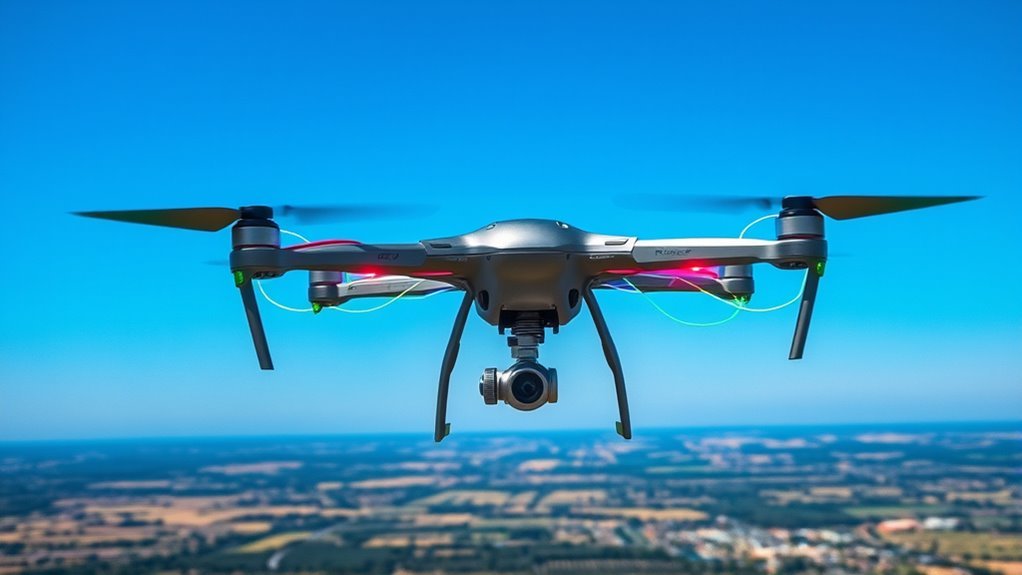
In practical terms, when data needs to be sent, the system converts it into pulses of light. These pulses are produced by a laser source or an LED, then launched into the fiber. Because fiber optic links typically offer higher bandwidth than traditional copper-based cabling—and also resist electromagnetic interference—the technology is widely used in telecommunications and networking. For fiber optic drones, these strengths translate into stable telemetry links, rapid command/response cycles, and consistent sensor streaming even in electrically noisy industrial settings.
By understanding these fiber optic basics—light pulse generation, guided propagation, and efficient signal transport—you can better appreciate why fiber-based drone communication is increasingly relevant for professional deployments. It supports high-speed data transfer, reduces susceptibility to interference, and helps teams connect systems with greater confidence in complex operational environments.
Key Components of Fiber Optic Drones
Although drones are often thought of as wireless aircraft, fiber optic drones add a specialized communication backbone that depends on optical components and motion-control electronics working together. A fiber optic drone typically combines advanced drone sensors, dedicated cabling, and a robust flight control system to manage both mobility and data flow.
Essential hardware elements
The most important components of a fiber optic drone usually include the following:
| Component | Function | Importance |
|---|---|---|
| Fiber Cables | Transmit data rapidly and efficiently using light pulses | Supports high-speed, low-loss communication |
| Drone Sensors | Collect environmental, operational, and payload data in real time | Enables accurate monitoring and responsive mission execution |
| Flight Controller | Processes inputs and manages stability, navigation, and control outputs | Ensures smooth and controlled flight performance |
Together, these systems allow the drone to capture mission data while maintaining reliable control and communication. The fiber cable ensures the connection between the drone and ground or onboard processing units remains fast and consistent, while the flight controller coordinates safe maneuvering in response to sensor feedback.
How the Data Transmission Process Works
The data transmission process in a fiber optic drone is engineered to keep communication fast, accurate, and stable from start to finish. It generally follows a sequence of steps: encoding, optical transmission through the fiber, and, when necessary, regeneration or amplification to maintain signal quality.
Step-by-step workflow
1) Data encoding into light pulses
The drone converts information—such as sensor readings, video streams, or telemetry—into a format suitable for optical transmission. This data is then encoded into light pulses produced by a laser or LED transmitter.
2) Guided propagation using total internal reflection
The light pulses enter the fiber cable and travel through the core guided by total internal reflection. Because the optical path is enclosed, the signal is less likely to be affected by electromagnetic noise, which can be common in industrial environments.
3) Signal attenuation management and amplification
As the signal travels, it may weaken due to distance, connector losses, bending, or environmental factors. To maintain performance, many systems rely on signal amplification or optical signal conditioning so that the receiving end can reconstruct the data accurately.
4) Reliable reception and data integrity
Finally, the receiver detects the light pulses, converts them back into electrical or digital signals, and verifies integrity. This helps ensure that the drone’s control commands and sensor outputs arrive with minimal errors—critical for real-time guidance, inspection accuracy, and rapid decision-making.
When implemented with proper optical design—appropriate fiber type, connector quality, and power budgeting—fiber optic drone communication can deliver consistent low-latency performance, supporting demanding use cases like high-precision inspections, perimeter surveillance, and data-rich imaging missions.
Where Fiber Optic Drone Systems Are Headed
As fiber optic technology continues to advance, fiber optic drones are expected to evolve in payload capacity, link efficiency, and operational flexibility. Future trends typically focus on improved optical transmitters (higher efficiency and better modulation), more robust signal conditioning methods, and tighter integration between sensor suites and flight control algorithms.
In parallel, system designers are exploring ways to reduce deployment complexity while maintaining the benefits of fiber-based communication. For industries that require guaranteed bandwidth and dependable sensor data—such as energy infrastructure, manufacturing plants, ports, and public safety operations—fiber optic drones offer a compelling path forward for mission-critical aerial monitoring.
📋 About This Article
This article explains how a fiber optic drone sends data by turning information into light pulses that travel through fiber optic cabling instead of relying only on radio. It’s written for curious readers, engineers, and operators who want to understand the basics of how these drones maintain stable, reliable communication. You’ll learn how the drone generates and transmits the light signals, how flight control and sensors work together during a mission, and how signal amplification may be used to keep data clear over longer distances.
Frequently Asked Questions
What is a fiber optic drone?
In practice, fiber optic drones can be built in different ways. Some are fully airborne but carry fiber-based sensors or use fiber for internal payload connectivity (e.g., connecting a camera or spectrometer to onboard processing equipment). Others are tethered or use fiber as part of a communication/data pipeline between the drone and ground equipment. The exact design determines how the drone “works,” but the common theme is that fiber optics are used to move optical signals with low loss and high reliability.
How does a fiber optic drone communicate data back to the ground?
1) Tethered or semi-tethered data links: The drone may deploy or remain connected to a fiber cable that runs to a ground station. Light pulses are encoded with information (using optical modulation) and sent through the fiber. At the ground station, a photodetector converts the optical signal back into electrical data for processing, recording, and display.
2) Onboard fiber-based payload connectivity: In some designs, the drone is not tethered. Instead, fiber optics may connect sensitive payload components (for example, certain sensors or imaging systems) to onboard electronics. In this case, the drone still transmits results over radio or another wireless method, but fiber is used inside the payload or for specific sensor paths.
In both cases, signal conversion and synchronization matter. Optical transceivers (laser/LED transmitters plus detectors), appropriate encoding/decoding, and error handling are used to maintain stable throughput. For tethered systems, mechanical management of the cable (tension control, spooling, and preventing snagging) is equally critical to reliable operation.
What role does the fiber optic cable play in the drone’s flight and control?
- Mechanical support and drag management: The fiber cable can add weight and drag, influencing maneuvering and stability. Many systems include a winch/spool, tension sensors, and control logic that manages cable payout and take-up to reduce tangling and keep the drone controllable.
- Trajectory constraints: Because the cable is a physical connection, the drone’s movement is constrained by cable length and routing. Control systems often account for the “pendulum-like” behavior of the cable and the changing effective payload load.
- Safety and fault handling: If tension becomes too high, the system may limit range, trigger a return-to-home, or execute a controlled landing. Fiber breaks or connector failures also require detection and fallback procedures.
- Power and signaling (in some designs): Some fiber-linked systems may carry power or use a hybrid approach where power is provided separately (e.g., battery/onboard) while fiber carries data. If power is delivered through a tether, voltage regulation and isolation become part of the design.
For untethered designs that use fiber internally, the fiber does not directly constrain movement as a cable would, but it still needs robust routing and strain relief so it can survive vibration and motion during flight.
How is video or sensor data handled in a fiber optic drone system?
A typical flow looks like this:
- Data acquisition: The drone collects information from a payload such as a camera, thermal imager, LiDAR, hyperspectral sensor, or other specialized instrument.
- Signal processing on the drone: The payload outputs analog or digital signals that may require conversion, compression, synchronization, and time stamping. Onboard processors may encode video (e.g., H.264/H.265 or other formats) or prepare sensor frames and metadata.
- Optical transmission via fiber (tethered systems) or fiber within the payload: The processed data is then transmitted through optical components. In a tethered configuration, optical transceivers send the encoded stream through the fiber to the ground. If the fiber is inside the payload, only the sensor-to-processing path uses fiber, while the final downlink may still be wireless.
- Ground station decoding and display/recording: At the receiver, an optical detector converts light to electrical signals. The ground computer decodes video and fuses sensor data, enabling real-time monitoring, analysis, and archiving.
- Latency and reliability features: Error correction, buffering, link health monitoring, and automatic switching (in hybrid designs) help keep latency low and improve continuity—important for inspection, surveying, and industrial use cases.
The exact method depends on payload requirements (bandwidth, frame rate, resolution) and the optical link’s specifications.
What are the main advantages and limitations of fiber optic drones?
Advantages:
- High bandwidth potential: Fiber can carry large amounts of data, supporting demanding payloads such as high-resolution video or advanced sensor streams.
- Lower electromagnetic interference: Optical signals are not affected in the same way as radio transmissions, which can improve performance near industrial equipment or in RF-challenged environments.
- Better signal integrity over distance: Fiber can maintain consistent quality over long runs, provided the optical link budget and connectors/splices are properly managed.
- Strong security characteristics: Physical access to the fiber (especially for tethered links) can make interception more difficult compared to many wireless links.
Limitations:
- Mobility constraints for tethered designs: The fiber cable can limit range, create drag, and introduce snagging or tangling risks.
- Added system complexity: Spooling/winch mechanisms, strain management, optical connectors, and fault detection increase engineering complexity.
- Deployment hazards: In cluttered environments, managing the cable path is critical to avoid damage and downtime.
- Weight and packaging: Fiber components, connectors, and internal routing (even in untethered designs) must be lightweight and vibration-tolerant.
In short, fiber optic drones are often chosen when robust, high-quality data transmission and interference resistance outweigh the operational constraints of the fiber-based architecture.
