
Drones are revolutionizing agriculture by enhancing efficiency, precision, and data collection, leading to smarter farming practices. They play a pivotal role in various agricultural applications, including crop monitoring, irrigation management, and pesticide application, providing farmers with a technological advantage in effectively managing their fields.
Benefits of Using Drones in Agriculture

The benefits of incorporating drones into agricultural practices are manifold. One of the most significant advantages is the increased efficiency in monitoring vast fields compared to traditional methods. Drones can cover extensive areas in a fraction of the time it would take a human or vehicle, allowing farmers to gather critical data quickly and accurately. For instance, a drone equipped with a camera can survey 100 acres in less than an hour, providing high-resolution imagery that would take days to achieve using ground-based methods.
Cost savings are another compelling reason for farmers to adopt drone technology. As drones reduce the need for manual labor and lower resource usage—such as fuel for tractors or the application of fertilizers—farmers can significantly cut operational costs. According to a study by the American Farm Bureau Federation, the use of drones can lead to a reduction in expenses for crop monitoring and management by up to 20%, making them an economically viable option for modern agricultural practices.
Types of Drones Used in Agriculture
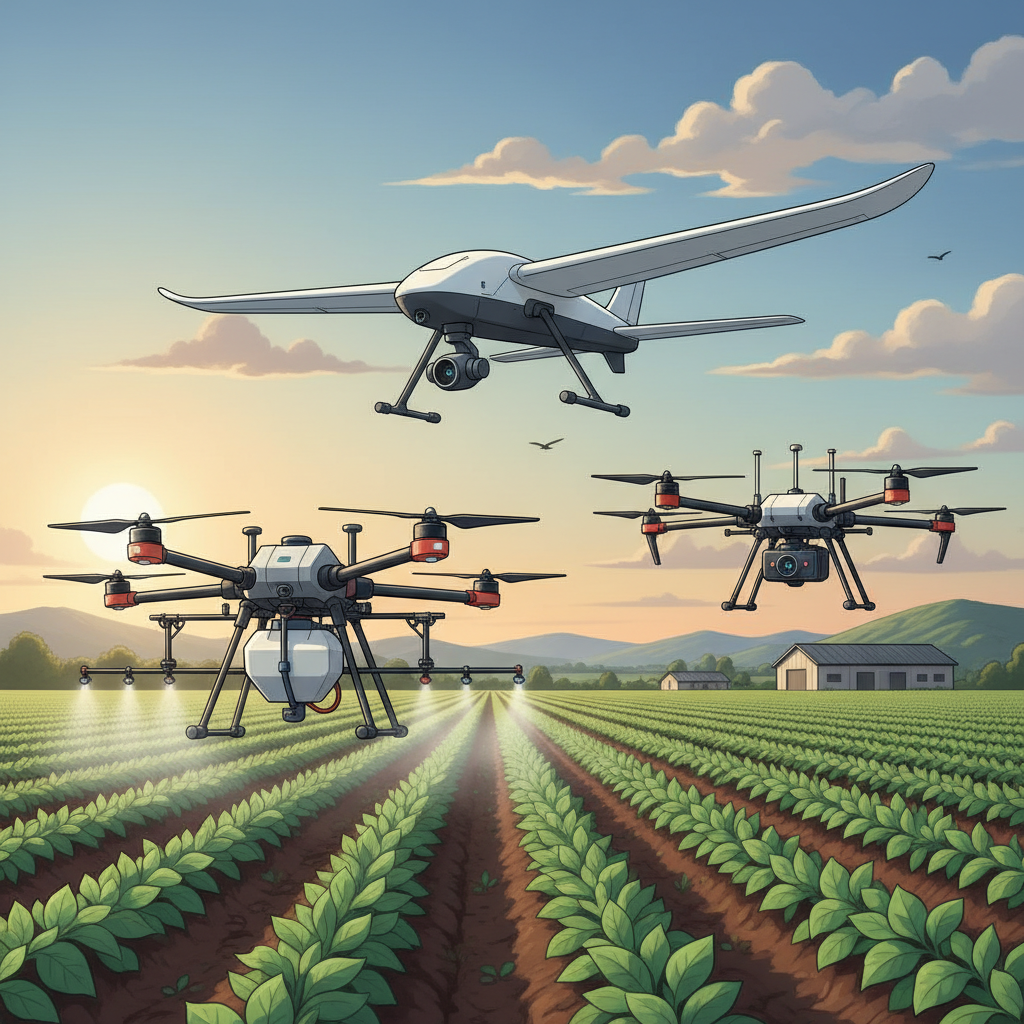
Drones in agriculture come in various types, each designed for specific applications. Fixed-wing drones are ideal for extensive aerial surveys and mapping. They can cover large areas with high efficiency and are particularly useful for creating detailed topographical maps that help farmers assess their fields’ conditions. For example, fixed-wing drones can be used to generate elevation maps for precision land leveling, which helps in optimizing water drainage.
On the other hand, multirotor drones are better suited for detailed inspections and targeted applications. Their ability to hover and maneuver in tight spaces makes them perfect for assessing plant health or applying pesticides in a localized manner. Farmers can utilize multirotor drones to fly over specific crop sections, ensuring that only the areas in need of treatment are targeted, thus minimizing chemical use and environmental impact.
Crop Monitoring and Health Assessment
Crop monitoring and health assessment are critical components of successful farming, and drones significantly enhance these processes. Equipped with advanced sensors, drones can detect plant health using the Normalized Difference Vegetation Index (NDVI), which measures vegetation health by analyzing light reflection. This data allows farmers to identify stressed plants early, combating potential issues such as nutrient deficiencies, pest infestations, or diseases before they escalate.
Real-time data collection is another advantage that drones offer. With the ability to capture images and data frequently, farmers can monitor their crops’ progress and make informed decisions promptly. For instance, a farmer can use drone imagery to determine the optimal time for irrigation or fertilization, thereby improving yields and resource management.
Precision Agriculture and Resource Management
Drones play a crucial role in precision agriculture by enabling the creation of detailed maps that facilitate variable rate application of fertilizers and pesticides. With the data collected from drones, farmers can apply inputs precisely where they are needed, rather than uniformly across the entire field. This not only boosts crop yield but also minimizes waste and environmental impact. For example, farmers can use drones to generate prescription maps that outline where to apply fertilizers based on soil nutrient levels, ensuring that each part of the field receives the correct amount.
Additionally, improved water management is another critical application of drone technology. Aerial imagery from drones can help identify dry areas within fields that require irrigation, allowing farmers to allocate water resources more efficiently. This targeted approach conserves water, reduces costs, and promotes sustainable farming practices, which are increasingly important in light of global water scarcity issues.
Data Collection and Analysis
The ability to collect and analyze data is one of the standout features of drone technology in agriculture. Drones provide high-resolution imagery that can be used for crop yield predictions and soil analysis. By analyzing the data collected, farmers can gain insights into their crop performance and make data-driven decisions that enhance productivity.
Integrating drone data with agricultural software further enhances its utility. Many farmers are now utilizing platforms that analyze drone-collected data in real-time, offering actionable insights. For instance, farmers can track crop health trends over time, assess the effectiveness of their management practices, and adjust their strategies accordingly. This kind of data-backed decision-making is essential in optimizing yields and ensuring long-term sustainability.
Challenges and Considerations
Despite the many benefits of drones in agriculture, several challenges and considerations must be addressed. Regulatory restrictions and airspace management can pose significant hurdles for drone operations. Farmers must navigate complex regulations regarding drone flights, which can vary by region. It is crucial for farmers to stay informed about local laws and obtain necessary permits to operate drones legally.
Additionally, the initial costs of purchasing drones and the need for technical training can be barriers to adoption for some farmers. While prices for drone technology have been decreasing, the investment can still be substantial. Furthermore, understanding how to effectively operate drones and interpret the data they collect requires training and expertise, which may not be readily available in all agricultural communities.
The Future of Drones in Agriculture
Looking ahead, the future of drones in agriculture appears promising, with numerous advancements on the horizon. Predictions for drone technology include the integration of artificial intelligence (AI) to enable smarter farming practices. AI-driven drones could analyze data autonomously, identify crop health issues, and even recommend specific interventions, streamlining the decision-making process for farmers.
Moreover, as the focus on sustainable farming practices intensifies, drones are expected to play an increasingly critical role. They can assist in monitoring environmental conditions, assessing biodiversity, and ensuring that farming practices align with sustainability goals. The potential for drones to contribute to greener farming methodologies positions them as vital tools in the face of climate change and resource depletion.
In conclusion, the use of drones in agriculture is revolutionizing the industry by providing innovative solutions for monitoring and managing crops. With their ability to enhance efficiency, precision, and data collection, drones offer farmers significant advantages in today’s competitive agricultural landscape. As technology continues to evolve, farmers can expect even greater benefits, making it essential to stay informed about these advancements. Embracing drone technology could be the key to achieving greater productivity and sustainability in agriculture, positioning the industry for future success.
Frequently Asked Questions
What are the primary benefits of using drones in agriculture?
Drones offer several key benefits in agriculture, including improved crop monitoring, precision farming, and enhanced data collection. They enable farmers to obtain real-time aerial imagery, allowing for early detection of issues such as pest infestations, nutrient deficiencies, or water stress. Additionally, drones can efficiently cover large areas, reducing labor costs and time, while increasing overall yield through targeted interventions.
How do drones help with crop monitoring and management?
Drones equipped with multispectral cameras can capture detailed images of crops, providing insights into plant health and growth patterns. By analyzing this data, farmers can identify areas needing attention, such as irrigation adjustments or fertilizer application. This capability not only maximizes resource efficiency but also leads to better crop management, ultimately resulting in higher productivity and reduced environmental impact.
Why should farmers consider investing in agricultural drones?
Investing in agricultural drones can lead to significant long-term savings and increased efficiency for farmers. Drones can perform tasks like soil analysis, crop scouting, and yield estimation much faster than traditional methods. By adopting drone technology, farmers can make informed decisions based on accurate data, ultimately enhancing crop health, reducing waste, and increasing profitability.
Which types of drones are best suited for agricultural use?
The best drones for agricultural use typically include fixed-wing models and quadcopters. Fixed-wing drones are ideal for covering large areas quickly and efficiently, while quadcopters offer versatility in close-range inspections. Additionally, drones with advanced sensors, such as NDVI (Normalized Difference Vegetation Index) cameras, are particularly valuable for assessing crop health and monitoring growth stages.
How can farmers integrate drone technology into their existing practices?
Farmers can integrate drone technology into their existing practices by starting with a clear understanding of their specific needs, such as crop monitoring or precision spraying. Initial steps involve selecting the right drone and obtaining any necessary licenses and training. Many farmers also benefit from collaborating with agronomists or drone service providers to analyze the collected data effectively, ensuring that drone usage enhances their overall agricultural strategy.
References
- https://en.wikipedia.org/wiki/Drone_technology
- https://www.usda.gov/topics/farming/drone-technology-agriculture
- https://www.sciencedirect.com/science/article/pii/S2351978917300301
- https://www.nature.com/articles/s41598-019-49396-1
- https://www.researchgate.net/publication/327400653_The_Use_of_Drones_in_Agriculture
- https://www.extension.iastate.edu/agdm/wholefarm/html/c5-61.html
- https://www.ars.usda.gov/oc/br/2021/drone-technology-in-agriculture/
- https://www.frontiersin.org/articles/10.3389/fenvs.2021.00067/full
